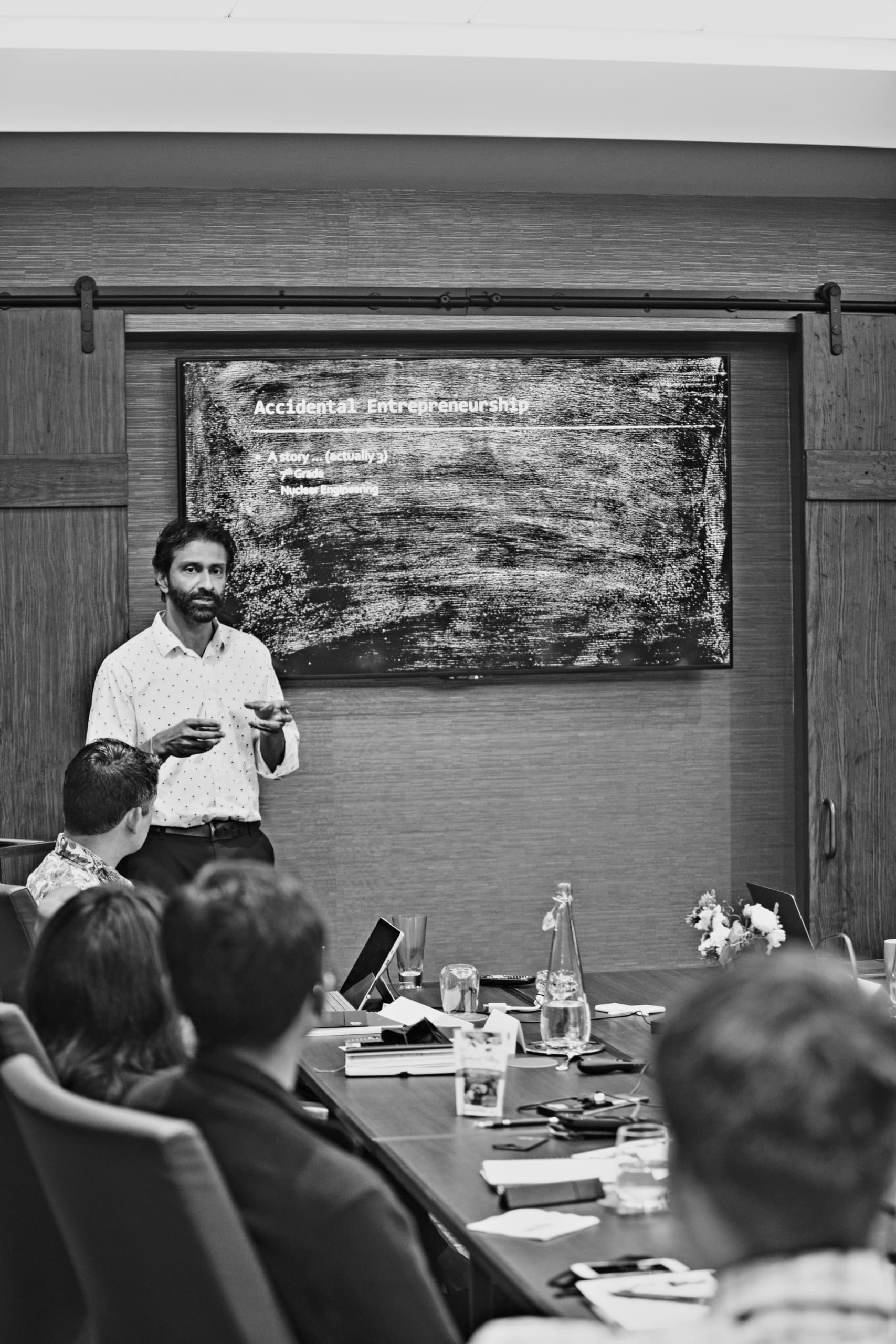
Academic mindset. No publication requirements. No politics.
Vision preserves the best of academic radiology—subspecialty depth, lifelong learning, and an accredited CME program. It is one expression of a broader culture where teaching, learning, and sharing knowledge happen every day—not because they're required, but because they're valued.
- Bi-weekly lectures, sharing interesting cases across the practice by our radiologists in real time
- Over 40% of our Visionaries have held academic appointments
- Nearly 30% are former Chief Residents
Vision was founded by two Johns Hopkins–trained radiologists who believed academic rigor and intellectual curiosity belonged in private practice. More than two decades later, that belief still shapes who we hire and how we practice.— On academic intelligence02 · FAQ
Questions about academics and CME.
Vision's CME program features approximately 25 live conferences each year, designed to support continuous learning and meaningful clinical discussion. Topics include emergency radiology, subspecialty imaging, quality improvement, medicolegal issues, and challenging cases identified through our Quality Assurance (QA) program. More than an opportunity to earn credits, our CME program reflects Vision's academic culture—providing regular opportunities for radiologists to learn from one another, share expertise, and continually refine their practice.
Yes. Physicians can earn 1 AMA PRA Category 1 Credit™ for each live CME conference they attend. Physicians who present at a conference may earn up to 4 AMA PRA Category 1 Credits™ through our Learning from Teaching program.
Vision's CME curriculum is developed by a committee of practicing Vision radiologists who identify educational priorities based on clinical practice, quality initiatives, emerging topics, and noteworthy cases. Many conferences are presented by Vision physicians who volunteer to share their expertise with colleagues, reflecting the collaborative, academic culture that has been part of the practice since the beginning.
In some states, yes. For example, Alabama requires 25 AMA PRA Category 1 Credits™ annually, which can be earned entirely through Vision's CME program. States with higher CME requirements may require additional education, but Vision's conferences can provide a significant portion of the credits needed for license renewal.
The curriculum reflects the breadth of modern radiology practice. Throughout the year, physicians attend conferences on emergency imaging, subspecialty topics, quality improvement, medicolegal issues, peer-reviewed case discussions, and lessons learned from our Quality Assurance program. Each conference is designed to strengthen clinical judgment while fostering collaboration, consultation, and lifelong learning that define Vision.
Some sessions are available on demand. Our Key Topics & Pitfalls series is recorded and available for later viewing. Other conferences, including Outside the Reading Room and Morbidity & Mortality, are offered live only because they involve sensitive clinical cases and candid discussion. These live sessions foster thoughtful conversation and shared learning, and we encourage physicians to attend whenever possible.
It depends on your medical license. If you're practicing under a training license, most states do not require CME. If you hold a full, unrestricted medical license, you'll typically need to meet your state's CME requirements, even during training. Many states offer exemptions or credit for time spent in an ACGME-accredited residency or fellowship program, but requirements vary. Our CME team can help you understand what's required for each license you hold.
In many cases, yes. Most state medical boards accept ACCME-accredited activities that offer AMA PRA Category 1 Credit(s)™. However, some states require additional education in areas such as opioid prescribing, ethics, or cultural competency. One CME activity can often satisfy multiple state requirements, but you'll still need to ensure you've met each state's specific mandates.
If you're audited, you're not on your own. Our CME Specialist works closely with our Licensing team to collect the required documentation and submit it to the appropriate medical board on your behalf. If additional information is needed, we'll work directly with you throughout the process.
Usually not. Most states require a minimum number of AMA PRA Category 1 Credits™. While many boards allow certain Category 2 activities, such as teaching, journal reading, or committee work, they generally cannot substitute for required Category 1 credits or satisfy state-specific mandates. Category 2 should be viewed as a complement to accredited CME, not a substitute.
Yes, when a course is required to maintain your medical license and no reasonable alternative exists. For example, if a state requires completion of a specific course—such as Delaware's Child Abuse Reporting requirement—and that course is the only way to earn the required credit, Vision will reimburse the cost.